Edited by Ramón Spaaij and Cindy Burleson
Sport and peacemaking have evolved. It is no longer the case that the Olympic Games and war games exist in isolation from each other. Increasingly, policymakers, peacekeepers, athletes, development workers, presidents of nations and others combine forces in an “integrated” approach towards peace.
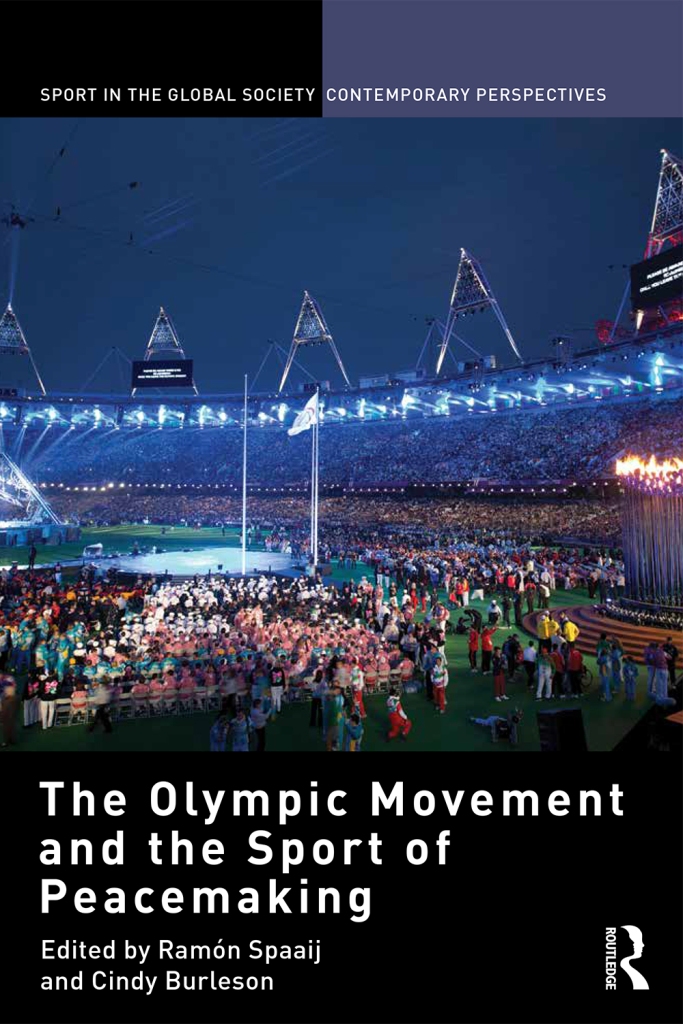
This approach is located not only within the broader, historically evolved Olympic Movement but also in relation to a newly emerged social movement which promotes development and peace through sport. This book critically examines the ways in which this development is being played out at global, national and local levels, particularly in relation to the Olympic Movement and initiatives such as the biennial Olympic Truce Resolution.
The volume constitutes a unique scholarly attempt to provide an in-depth comparative analysis of the sport of peacemaking in the context of the Olympic Movement. Through international comparison and empirically grounded case studies, the book provides an important new departure in the study of the social impact of the Olympic Movement and related peacemaking efforts. It discusses these issues from a range of academic disciplines, including history, sociology, political science, economics, geography, philosophy and international relations.
This book was previously published as a special issue of Sport in Society.
Routledge | 31 May, 2013
ISBN 9780415618786
Contents
Introduction
Olympic rings of peace? The Olympic movement, peacemaking and intercultural understanding by Ramón Spaaij
Part I: Philosophical and historical foundations
- The power of sport in peacemaking and peacekeeping by Jim Parry
- Pierre de Coubertin’s vision of the role of sport in peaceful internationalism by Irena Martínková
- The ancient Olympic Truce in modern-day peacekeeping: revisiting Ekecheiria by Cindy Burleson
Part II: Global politics and international relations
- An overlooked path to peace and stability: sport, the state, and the case of the Koreas by Darin H. Van Tassell and Dené A. Terry
- Transforming an international organization: norm confusion and the International Olympic Committee by Dan Bousfield and Jean Michel Montsion
- More than just Games: the global politics of the Olympic movement by Liam Stockdale
Part III: Development and peace legacies
- The Paralympic Games as a force for peaceful coexistence by Ian Brittain
- Olympism in Action, Olympic hosting and the politics of ‘sport for development and peace’: investigating the promises of Rio 2016 by Simon Darnell
- Accounting for legacy: monitoring and evaluation in sport in development relationships by Tess Kay
- Epilogue: London 2012 and beyond: concluding reflections on peacemaking, sport and the Olympic movement by Ramón Spaaij and Cindy Burleson
Editors
Ramón Spaaij
Ramón Spaaij is an Associate Professor in the Institute of Sport, Exercise and Active Living at Victoria University, Australia, and holds a Professorial Chair in Sociology of Sport at the University of Amsterdam, the Netherlands. His publications include Sport and Social Exclusion in Global Society (2014) and Sport and Social Mobility: Crossing Boundaries (2011).
Cindy Burleson
Cindy Burleson is Chair of The International Sibling Society, Hattiesburg, Mississippi, USA.
The Olympic Movement and the Sport of Peacemaking
Related Writing
Giving peace a sporting chance – Book on the Olympics and peace by Ramón Spaaij in University World News
 Ramón Spaaij